Mario
- This article is about the titular main protagonist of the Super Mario franchise. For other uses, see Mario (disambiguation).
- "Jumpman" and "Jump Man" redirect here. For other uses, see Jumpman (disambiguation).
- Not to be confused with Mari.
| Mario | |
|---|---|
 Artwork from Mario vs. Donkey Kong for the Nintendo Switch | |
| Full name | Mario Mario[1] |
| Species | Human |
| First appearance | Donkey Kong (1981) |
| Latest appearance | The Super Mario Galaxy Movie (2026) |
| Latest portrayals | Kevin Afghani (2023–present) Chris Pratt (2023, 2026) |
- “It's-a me, Mario!”
- —Mario, Super Mario 64
Mario is the main character and titular protagonist of the long-running and highly successful Super Mario franchise. He was created by Japanese video game designer Shigeru Miyamoto and serves as the main mascot of Nintendo. Mario made his first appearance as the protagonist of the arcade game Donkey Kong, released in 1981 (which used the names "Jumpman" and "little Mario" in associated paratext). Since Super Mario Bros., his trademark abilities have been his jumping and stomping powers, with which he defeats most of his enemies, and his ability to gain even more powers with a plethora of items, such as the Super Mushroom, the Fire Flower, and the Super Star. Games have usually portrayed Mario as a silent, straightforward character. According to Nintendo's philosophy, this allows Mario to fit in many different genres and roles. In the mainline games, he is mostly the hero who goes on an adventure to save Princess Peach from his arch-nemesis, Bowser. However, Mario has been shown doing many other activities besides adventuring, such as racing and sporting with his younger but taller twin brother, Luigi; his friends such as Yoshi and Toad; and many other characters.
Creation

Following the failure of Radar Scope in North America, Nintendo's then-president, Hiroshi Yamauchi, requested designer Shigeru Miyamoto's aid in converting unsold Radar Scope units into something that would sell well. Miyamoto conceived the concept of a love triangle and decided to make a game based on Popeye. This was abandoned due to technical reasons, so he decided to come up with a new idea using his own characters.[2]
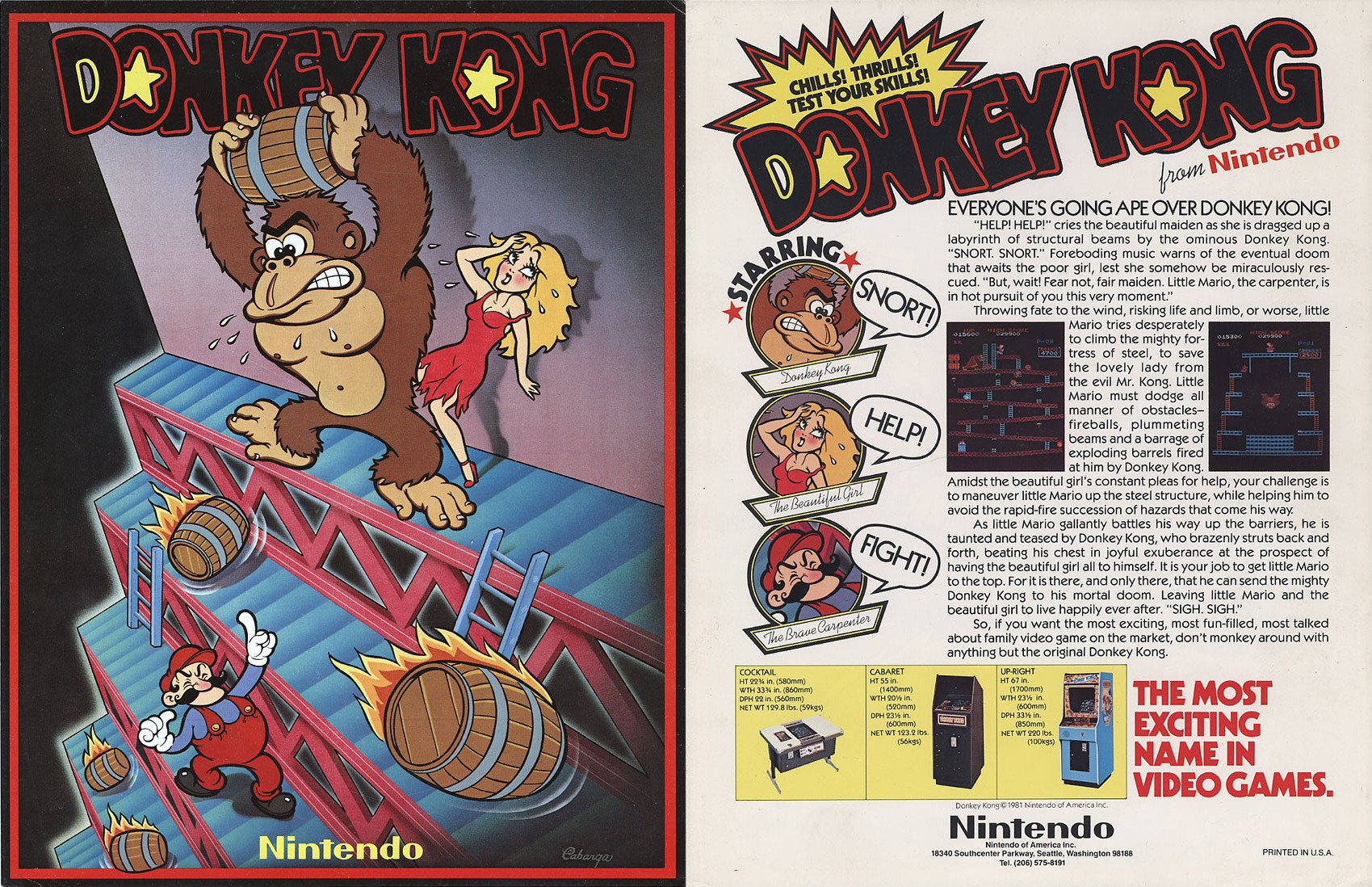
For use in his arcade game Donkey Kong, Miyamoto created a player character originally known during development as Ossan (おっさん, the Japanese term for "middle-aged man", which coincidentally would be the name given to a Mario look-alike in the game Golf), then Mr. Video Game or Mr. Video (ミスター・ビデオ) and Jumpman.[3][4][5] This character was given red overalls and a blue shirt in order to make the arms more visible as well as a cap and mustache, as hair and a mouth were impossible to animate on the arcade system.[6] When the game was released in Japan, he was simply a nameless "player" (プレイヤー) in the Japanese arcade instructions and flyer. In the American arcade instructions, he was called Jumpman, but Nintendo of Japan asked Nintendo of America if it wanted to rename him during the Western localization. President Minoru Arakawa and warehouse manager Don James thought it would be funny to call the character Mario after the reclusive American landlord of storage and company housing, Mario Segale.[7][8][9][10] It was too late to replace the Jumpman name from the instructions, but the "Mario" name appeared on the flyer that was published a few weeks after the game's debut.[11] He was called "Mario" in the American instruction manuals of the Atari 2600 and ColecoVision ports of Donkey Kong released in July 1982, predating his appearance in Donkey Kong Jr. in August 1982.[12][13] In Japan, he became known as Mario with the release of Donkey Kong Jr. Prior to this, the Japanese instructions for the Game & Watch version of Donkey Kong called him Kyūjo Man (救助マン, lit. "rescue man").
While Mario was initially described as a carpenter, Mario Bros. subsequently changed his occupation to a plumber because "the scenario dictates his role".[14] In a 2009 radio interview, Miyamoto stated that he wanted to create a hero resembling an "ordinary odd-job man"; he did not like the idea of a perfect hero, preferring the idea of "ordinary citizens doing something really good for society", and would be "embarrassed" for making a perfect hero. He stated, "I like the idea of a middle-aged ordinary man doing something nice for other people".[15]
Cultural impact
- Main section: Super Mario (franchise) § Reception and legacy

- “He's the icon. He's the GOAT.”
- —A child talking about Mario in a Play Nintendo video[16]
Mario is often said to be the most famous video game character in history. A Q Score survey made in the early 1990s showed Mario was even more popular than Mickey Mouse,[17] and Mario has the only wax statue of a video game character, which stands in the Hollywood Wax Museum.

The Super Mario franchise is the best-selling video game franchise in history. Even with spinoff series excluded, the main Super Mario franchise has sold 311.46 million games (as of September 2015).[18] Furthermore, Super Mario is the flagship franchise of Nintendo, and Mario is the company's mascot, furthering his publicity even more. According to Guinness World Records 2008: Gamer's Edition, Mario has appeared in a total of 116 separate games, which is more than any other video game character,[19] and more recent sources such as the Game On 2.0 traveling exhibit place the number at over 200.[20]
General information
Physical description


Mario's distinctive look is due to technology limitations in the mid-1980s, as well as Nintendo's inability to depict Popeye. With a limited number of pixels and colors, the game developers, including Mario's creator, Shigeru Miyamoto, could not animate Mario's movement without making his arms "disappear" if his shirt was a solid color, so they gave Mario overalls. The developers additionally did not have the space to give him a mouth, the result of Mario's mustache. Mario has a big nose to have his face read better in the limited pixel space. Mario was made stocky so he covers best in the space he was allocated in. Finally, the developers used a cap to bypass the problem of animating and drawing hair. Mario's gloves were a later addition by the illustrator Zavier Leslie Cabarga for the North American flyer for Donkey Kong.[21] Miyamoto and Cabarga both drew him with having just four fingers per hand, which was carried over to Saturday Supercade.[22]
Mario had undergone major changes from his initial appearance in Donkey Kong up until Super Mario Bros. 3. In Donkey Kong, Mario initially appears lankier with a more realistic-looking red nose and a cleft chin. In some portrayals in Donkey Kong Jr., however, he appears stouter with a round nose, which more closely resembles his current design, although some promotional art retains his original Donkey Kong design. The stubbier design is retained in Mario Bros., with a few changes. Super Mario Bros. marks the first time he has blue eyes, full hair, a red cap with an insignia, a distinct mustache, a large round nose, large hands, and other features. It would not be until Super Mario Bros. 3 where his modern design would debut; he would become taller and skinnier, and his overalls and shirt would be reversed in color. However, his in-game design did not fully match artwork, such as having black hair like his mustache instead of brown, white overall buttons instead of yellow ones in Super Mario World, and hair that had a more reddish-brown color and was not very defined in shape below his hat in Super Mario 64. Before Super Mario Bros. 2, the colors of his shirt and overalls were reversed until Super Mario World and the remade sprites of Super Mario All-Stars, and he also did not wear his gloves. His neck is very short and barely visible due to his round and slightly disproportionate head compared to the rest of his body and the position of his chin.
While Mario is consistently portrayed as a short character, his precise height and proportions vary across media, without a specified height from most video game material, with Super Mario Sunshine even stating that his height is unknown and his weight is a secret.[23] A life-size figure of Mario sold by online retailers has a height of 150 cm (4 ft 11 in.),[24] with another variation standing 155 cm (5 ft 1 in.) tall.[25] The pamphlet for Super Mario Bros.: Peach-hime Kyūshutsu Dai Sakusen! gives his height as 150 cm and weight as 70 kg (154 lbs), while the Super Mario Daishūgō 4koma Gag Battle manga states that his height is 165 cm (5 ft 4 in.).[26] In a Super Smash Bros. commercial, he is 5 ft (152 cm) tall, while his eye level is 4 ft (122 cm) tall.[27] Crossover artwork featuring Mario and Sonic the Hedgehog (who stands at 1 m [3 ft 3 in.] tall)[28] shows Mario at around the same height as the latter, if not five to seven centimeters (two or three inches) shorter due to Sonic's quills. Mario's height relationship with other humans has been varied. Some media, such as Super Mario Odyssey and Mario's Time Machine, show Mario as much shorter than a realistic human. Despite this, by cross-referencing the measuring units displayed in Balloon World with the environment, it is possible to determine Mario is still around 155 cm (5 ft 1 in) tall.[29] Other media, including Mario Golf and the DIC cartoons, show Mario's height as being closer relative to other humans. The director of Super Mario Odyssey, Kenta Motokura, stated in an interview that New Donk City was realistic to showcase the extent of Mario's abilities in a realistic environment for a scale that is easy to understand,[30] while Miyamoto referred to the humans of New Donk City as "normal people".[31] Miyamoto deliberately designed Mario to be shorter than his enemies and damsels-in-distress.[32]
Merchandise for the original Donkey Kong shows Mario as balding, although most media depict Mario with a full set of hair. He has short chocolate brown hair with three front locks, four back locks, and a sprout-shaped cowlick on the top of his head. Over the years since Super Mario Bros. (omitting stylistic variations such as depictions in Paper Mario), Mario has received a change in stature; he is shown to be much stubbier in his earlier appearances compared to his more recent appearances, starting with Super Mario 64. Mario's legs and arms have grown longer over the years, giving him a slimmer look. This may have been the result of Miyamoto's response to Mario's and Luigi's "cute" appearances, and he considered redesigning the Mario Bros. to "become a bit more grown-up" in the GameCube era—for instance, by removing their trademark V sign.[33]


Mario's most prolific early 3D iteration is from Super Mario 64, where he and other characters were created from Silicon Graphics workstations. Mario is depicted with darker blue overalls and bigger eyes than in his current appearance based on the one in Luigi's Mansion. He has slightly darker skin, his ears are also rounder, his overall straps are longer, and his cap is less round. Ever since Luigi's Mansion, however, Mario has received only minor proportion changes to his general appearance, becoming taller and slimmer, though still chubby, and with brighter colors on his clothes, skin, and hair; pockets on his overalls; and added detail in his shoes, eyes, hat, and clothes in 3D artwork since Super Mario 3D World. While he always has a fair complexion, the tone of his skin has become inconsistent over the course of the more recent games, sometimes taking on a peach tone like in the more recent artwork, including the updated versions of the existing ones, and at times not. The detail on his hair and mustache is sometimes depicted inconsistently across games and media in recent appearances; Super Mario Odyssey, official renders of Mario Golf: Super Rush, and a few promotional renders[34] depict his hair as individual strands; most other games and media depicted them as singular meshes with simpler detail instead. Rivets have also been added to Mario's overalls starting in renders for Super Mario Odyssey, and they can be seen in his in-game model for Nintendo Switch 2 installments.
Mario has a few stylistic variations across some games, sometimes within a series. One variation is Mario's overall appearance in the Paper Mario games: It is generally the same, with black dots for eyes and no eyebrows, although he has a shorter stature. Since Paper Mario: The Thousand-Year Door, however, Mario's body is more simplistic, with legless feet, a rounder face, and a full outline around the arms, while his mustache is a lighter brown. In addition, starting with Mario & Luigi: Paper Jam, all of Mario's paper appearances have depicted him with a white outline around his entire body. Another variation is Mario's depiction in the Mario & Luigi games, although it is more subtle, where Mario is given black eyes rather than blue. The artwork for the series, including the box art of the games, shows Mario with a serious or neutral expression that never leaves his mouth visible underneath his mustache, unlike with Luigi, who is shown with a larger variety of expressions depending on the situation. In Mario & Luigi: Brothership, Mario's appearance has a cartoonish cel-shading style with shades of purple around his hat and shirt, matching the shading in the series' artwork.
The Super Smash Bros. series also has Mario's appearance change between games. In the original Super Smash Bros., Mario's appearance is derived from Super Mario 64 but with minor alterations, such as a slimmer appearance. In Super Smash Bros. Melee, Mario's design incorporates elements from Mario Kart 64 and Super Mario World, as well as official artwork from the Nintendo 64 era. Mario's hair and clothing are darker and have more detail in them, with his overalls particularly sporting back pockets and having denim textures, similar to his sprite in Super Mario World, and his skin having a more original tan complexion. In Super Smash Bros. Brawl, Mario's back pockets return, but his overall design is updated to resemble his appearances in Super Mario Sunshine and later games. Compared to his mainline counterparts, however, Mario has smaller hands, longer limbs, and a longer neck, lending to a slimmer appearance. Mario's color scheme is also darker than before, while his hair and clothing have more realistic detailing. In Super Smash Bros. for Nintendo 3DS / Wii U, Mario's design, while retaining the proportions from Brawl, is vibrant and his overalls no longer have back pockets, matching his mainline counterparts somewhat more closely. As an accompaniment, Mario's hair and clothing have much less detailing. In Super Smash Bros. Ultimate, Mario's design is mostly the same as before, aside from a more subdued color scheme and simple detailing in his hair and clothing, but not to the same extent as Melee and Brawl. Super Mario Odyssey has realistic details on his hair and overalls, and some other games also retain the realistic details to an extent.
Clothing

Mario is typically shown wearing his trademark outfit wherever he goes. He has a long-sleeved red shirt, which is tucked under a pair of white gloves and has a noticeable collar at the neck. He also wears blue overalls with yellow (which is usually rendered gold in certain games and renders) buttons layered over his shirt. His light-brown work shoes are referred to as boots in the Paper Mario series, and they are shown to have a rim on the top, although Mario's shoes in most media do not have this rim.
Originally, Mario wore red overalls on top of a blue shirt—nearly the opposite colors of what he wears now. The Famicom version of Mario Bros. is the first game to depict Mario with blue overalls and a red undershirt (although on the box art, he is depicted entirely in blue), but Super Mario Bros. 2 standardized Mario's current colors, with the exception of the box art. However, Mario still wears red overalls and a blue shirt in the DIC cartoons.
Mario's trademark is his red cap with his red "M" insignia. Mario's cap is sometimes an important and even mandatory accessory in some games, such as Super Mario 64, where he takes more damage without his cap. In Super Mario Sunshine, if Mario loses his cap, he acquires damage over time from the heat of the sun. In most media, however, Mario's cap is treated as a mere accessory, and Mario can go capless in some games without any additional effect, such as in New Super Mario Bros. Wii after obtaining 99 lives. In some games, such as Super Mario 3D Land and Super Mario 3D World, if Mario is in Small form, he is seen without his cap, although it is no different from the other incarnations of the Small form. In Super Mario Odyssey, Mario's default cap is replaced with Cappy, which can be replaced with other hats in the Crazy Cap stores as well. Additionally, Mario has over 40 outfits available to wear, which can range from recolors to resemble Luigi, Wario, or Waluigi to unique outfits that see Mario dressed as a pirate, as an astronaut, as a knight, as a musician, in swim attire, or even as Princess Peach in her wedding gown.
Although mostly seen with his default plumber attire, Mario has also worn several alternate outfits in the spinoff games, including but not limited to Mario Party games, Dr. Mario, NES Open Tournament Golf, Mario's Picross, the Mario Strikers games, Mario & Sonic at the Olympic Games Tokyo 2020, and Mario Golf: Super Rush. In Mario & Sonic at the Olympic Games Tokyo 2020, Mario wears different outfits depending on the sport or activity being played. In some sports, Mario wears the same red sneakers he originally wore in Mario Tennis Aces.
Mario has seen some variations to his outfit in the games. In Super Mario Sunshine, for instance, Mario has shorter sleeves. In addition, Mario can wear a tropical shirt over his normal shirt, along with sunglasses that darken the screen, if he talks to the Sunglasses vendor. Mario also usually gains alternate outfits when using power-ups, from simple recolors to covering his whole body, such as Fire Mario, Tanooki Mario, Propeller Mario, Flying Squirrel Mario, and Cat Mario. Finally, Mario can resemble different characters, even outside the Super Mario franchise, by using a Mystery Mushroom to change into one of the various forms of Costume Mario in Super Mario Maker.
Within the Super Smash Bros. series, Mario has several alternate colors to use, with two costumes in Super Smash Bros. Ultimate, most referencing existing characters throughout the Super Mario franchise.
Age

Mario was originally imagined as middle-aged since his debut in Donkey Kong,[35] and Mario & Luigi: Superstar Saga and Mario & Luigi: Superstar Saga + Bowser's Minions also depict him as middle-aged.[36] In an interview about Super Mario 64, Shigeru Miyamoto said Mario was a "weird old dude".[37] However, Super Smash Bros. Melee approximates Mario's age to be about 26 years old,[38] while Miyamoto later placed it at either 24 or 25.[39] The pamphlet for Super Mario Bros.: Peach-hime Kyūshutsu Dai Sakusen! also estimates Mario's age at around 25. The comic Mario vs. Wario also implies Mario (and Wario) is roughly in his late 20s or early 30s, as he recalls his childhood 20 years ago.
Name
- “JUMPMAN! Wait, who?”
- —Glitz Pit audience, Paper Mario: The Thousand-Year Door
Mario's family name is given as "Mario" in the live-action segments "Dance", "Home Radio", and "Treasure of the Sierra Brooklyn" of The Super Mario Bros. Super Show! and made popular in the live-action movie Super Mario Bros. This occasionally occurs in other media—for instance, the Prima guidebook for Mario Party 2 lists his name as Mario Mario in a note section,[40] and the Prima guide for Mario & Luigi: Superstar Saga similarly shows Mario's full name as Mario Mario in the list of major characters.[41] The arcade flyers for Donkey Kong, Donkey Kong Junior, Mario Bros. use the full name as well. Also, when people asked Mario (voiced by Charles Martinet) on MIRT what his last name was at San Diego Comic-Con 2012, he responded with this: "What's my last name? Ah, that's a very good question! ... That's right! It's-a Mario. My name-a Mario Mario. Of course, my brother name, a-Luigi Mario. And of course, my mama's-a Mama Mia Mario; my papa Papa Pio Mario. Of course, my grandmama Grandmama Mia Mario, and my grandpapa Grandpa—et cetera, et cetera. Yeah, first name Mario, last name-a Mario. Yahoo!"[42] However, Nintendo of America earlier claimed that "there are no last names".[43] This was later stated by then-Nintendo president Satoru Iwata.[4] Additionally, Shigeru Miyamoto previously stated that Mario and Luigi do not have last names, contrary to their depiction in the movie, although he later redacted that stance, confirming at the Super Mario Bros. 30th Anniversary festival in September 2015 that Mario's and Luigi's last names are indeed "Mario".[1]
Personality

- “One of the things that's interesting about Mario is that there's very little character to him. You know very little about him. So despite the fact that he's incredibly well-known, incredibly visible and recognized, we know very little about his backstory, his history, or his motivations, so he's not much of a character in the traditional film or TV sense.”
- —James Newman, senior lecturer of cultural studies of Bath Spa University, 2009 radio interview[15]
Mario is a heroic Italian plumber, with media outside the games depicting him from Brooklyn. Mario is known for being kind, cheerful, playful, encouraging, courageous, and headstrong, and he is also eager and cocky on certain occasions, usually during competitions. Officially, however, Nintendo producers have stated that Mario's biography is kept simple in order to make him versatile and reusable in many different games and situations.[44] Although competitive, Mario has good sportsmanship such as from Mario Kart 8 (there is a chance he says, "Good play!" when he is in second to sixth place) and Fortune Street (see his various losing quotes). When he loses, he does exhibit some frustration, but reactions are typically disappointment and resignation versus the more over-the-top cartoonish reactions by other characters.
Mario has occasionally shown assertive tendencies throughout his appearances, especially in contrast to Luigi's and Princess Peach's more cautious approaches, albeit in a lighthearted and comic-relief manner. In Super Mario RPG: Legend of the Seven Stars, Mallow has to physically restrain Mario from charging in, such as before the battle with Bowyer, so that the heroes can figure out what is happening to their surroundings. In the beginning of Mario & Luigi: Superstar Saga, when Mario hears that Princess Peach is in distress, he sprints out to get dressed and accidentally drags Luigi behind him.

Mario loves food, especially Italian food, which is mostly seen in the DIC cartoon trilogy but is also shown in the games such as in Super Mario 64 and Super Mario Odyssey, where he dreams about Italian food; Super Mario Sunshine, where he is attracted to the promise of seafood, remarks sadly that the disturbed Delfino Airstrip resembles a "giant, empty plate", and frets that he is going to miss dinner.[45] Super Mario Sunshine also states that spaghetti is Mario's favorite food.[23] In Luigi's Mansion 3, Mario is drawn to a food display in the Grand Lobby, and in Fortune Street, he offers Yoshi to help look for cookies before suggesting that he has already eaten the cookies ("just give me a second to brush these cookie crumbs out of my mustache!"). Mario is pickier in The Super Mario Bros. Movie, however, showing his disgust at mushrooms. Characters also occasionally suggest he pay attention to his diet, such as Hoot from Super Mario 64 and the Star Temple gate from Mario & Luigi: Partners in Time.
Speech
Mario did not speak in any games from the 1980s to the early 1990s due to each system not having the required storage to fit voice clips without compromising graphical fidelity. Despite the increase of storage, Mario was still not given voice acting on the Super Nintendo Entertainment System. The MS-DOS version of Mario Teaches Typing was the first game to introduce voice acting for Mario, where he was voiced by Ronald B. Ruben, while the CD-ROM version was the first to feature voice acting by Charles Martinet.
Since then, like many other protagonists of Nintendo games, Mario has rarely spoken in full sentences in most of the mainline video games, usually making him a semi-silent protagonist. In early games, however, Mario fully speaks for long periods of time, such as in Mario's Game Gallery and Mario Teaches Typing 2. In the Japanese version of Super Mario Sunshine, which retains the English voice acting, Mario (Charles Martinet) speaks full sentences and holds a full conversation with Toadsworth (Scott Burns) in the cutscenes.[46] Mario's voice in the video games (by Martinet and Kevin Afghani) is characterized by broken English with a heavy Italian accent and in a soft, tenor voice, with him often referring to himself in the third person as illeism. When he screams or is happy or excited, his voice tends to go falsetto. According to Martinet, the high-pitched voice was chosen as a deliberate contrast from the gruff Brooklynite dialect typically associated with Italian-American characters, as he considered the rougher voice inappropriate for a child audience.[47] There are some games where Mario has also been given complete dialogue bubbles, such as Itadaki Street DS and Fortune Street. Mario has also spoken in full sentences in various promotional events, such as the 2006 interview for New Super Mario Bros.,[48] a press conference released for Mario Sports Mix, the Nintendo 3DS system demonstration,[49] and Play Nintendo's series Mario Reads Your Letters. In promotional venues with MIRT, people can communicate with Mario by asking various questions; there, too, Mario speaks for long periods of time.[42][50][51] On The Cat Mario Show, Mario can speak fully, but he has an entirely different voice that is pitch-shifted higher. After the GameCube era, Martinet made a slight change to the way he voices Mario, using his tenor voice more consistently and taking on a slightly lower pitch to make him more expressive, while in the Super Smash Bros. games from Super Smash Bros. Brawl onwards, Mario's voice became deeper and raspier than usual, similarly to Super Mario Galaxy. In Super Mario 3D World, as well as various games from the Nintendo Switch era (including Super Mario Odyssey and Luigi's Mansion 3), Mario's voice has become noticeably deeper and slightly weaker in energy due to Martinet aging. In Super Mario Bros. Wonder, after Martinet stopped voicing Mario, Afghani succeeded him and gave Mario a similar but slightly higher-pitched voice.
Most non-game media, such as comics, manga, anime films, and cartoons, also show Mario speaking. In the cartoons and The Super Mario Bros. Movie, Mario is usually associated with a Brooklyn accent, the former with a gruff voice, though his non-English voices in the latter vary, with some imitating his high-pitched voice in the games and others having a generic young adult-like voice. Mario speaks in the various anime films and shorts such as in Super Mario Bros.: Peach-hime Kyūshutsu Dai Sakusen!, though his voice is not as gruff as in the cartoons.
Likewise, in some cases, Mario is a true silent protagonist, or he does not speak in English. In Super Mario RPG: Legend of the Seven Stars, Mario is completely silent, communicating solely through pantomime. In the Paper Mario titles, he mainly communicates through simple nodding and hand gestures; while he is completely silent in Paper Mario, however, he is given his usual voice in Paper Mario: The Thousand-Year Door and Super Paper Mario. Mario is also silent during dialogue scenes in the Super Mario Stadium series, Mario Tennis Aces, the Mario Golf series, and the Mario & Sonic series, although he does say the usual catchphrases in a game session. In these games, other characters speak for him, mainly Lakitu and Toad. In the Mario & Luigi titles, Mario and Luigi speak in unintelligible Italian-sounding gibberish that the other characters can understand.
 Mario Teaches Typing 2 - Mario's voice Mario Teaches Typing 2 - Mario's voice | File info 0:11 |
Powers and abilities

Mario's primary ability is his jump, which he relies on to navigate platforms, defeat enemies, avoid hazards, and activate helpful items, such as ? Blocks and P Switches. This ability is a result of Nintendo's game design philosophy, especially during development of earlier Super Mario–franchise games, to allow a very simple ability to accomplish a great variety of tasks. Although Luigi jumps higher in some games, Mario is also agile, capable of several acrobatic maneuvers, including the Long Jump, Backward Somersault, Spin Jump, and Wall Jump, with the Wall Jump being one of his most recurring abilities. Several of these abilities are later shared with other Super Mario characters. Some games depict Mario as immune to fall damage, such as in Super Mario Galaxy and Super Mario Odyssey, though landing still impacts him, while other games such as Super Mario 64 have him taking damage; Mario can be instantly defeated by falling great heights in the Donkey Kong games. While Mario usually jumps for his attack, he can punch and kick in a few other games such as Super Mario 64, games in the Mario Party series, and games in the Super Smash Bros. series.
With power-ups, Mario can transform in a number of different ways to augment his abilities or even gain entirely new ones. His most iconic power-up is Super Mushroom, which makes him the larger, stronger, and more resilient Super Mario. Mega Mushrooms further increase Mario's size, making him the nearly invincible Mega Mario. This size power is referenced in other games without relying on items, such as with Enlarge in Mario Super Sluggers, Super Mario! in Mario Strikers Charged, and Mario's taunt in Super Smash Bros. installments prior to Super Smash Bros. Ultimate. Other common items Mario can acquire are those that grant invincibility, the most recognizable being the Super Star, but other examples include the aforementioned Mega Mushroom and the Metal Cap. The Fire Flower makes Mario become Fire Mario, and allows him to throw Fireballs to attack from a distance. Mario can also use similar items that grant access to different kinds of projectiles, such as the Ice Flower and its Ice Balls and the Boomerang Flower and its boomerangs. Some items, such as the Frog Suit in Super Mario Bros. 3 and the Spring Mushroom in Super Mario Galaxy, allow him to jump or bounce even higher than normal. A great number of items grant Mario the ability to fly, such as the Super Leaf, Cape Feather, Wing Cap, Propeller Mushroom, Bee Mushroom, and Red Star.
Mario's main weapon is the hammer in Donkey Kong; Mario often also uses the hammer as a weapon in Super Mario RPGs.


Mario is associated with fire in some spinoff games, likely in reference to Fire Mario. It is not until the 2000s, however, where Mario uses fire to augment his moveset. The spinoff series that regularly affix Mario fire abilities include Mario Golf (after Mario Golf: Toadstool Tour where his Nice Shot encases the golf ball in flames), Super Mario Stadium (Mario's team name in both Mario Superstar Baseball and Mario Super Sluggers is Mario Fireballs), and Mario Strikers. Other games include Mario Hoops 3-on-3, Mario Sports Mix, and Puzzle & Dragons: Super Mario Bros. Edition. While not a regular occurrence throughout the rest of the Mario & Luigi series, Mario can use Firebrand in Mario & Luigi: Superstar Saga and has fire-based special moves in Mario & Luigi: Brothership. Mario has the fireball as his special item in some games such as in Mario Kart: Double Dash!! (along with a kart named Red Fire), Mario Kart Arcade GP installments, Mario Party 7, and Mario Kart Tour, although these are also not common in the rest of the series for these installments.
The Super Smash Bros. series includes Mario's ability to shoot a fireball in the first game, although this is likely simply a reference to Fire Mario. Starting with Super Smash Bros. Melee, Mario's side smash attack is a powerful palm thrust with a burst of fire. It replaced a strong punch from the first game. Super Smash Bros. Brawl later expands on Mario's fire powers by giving him a fire-based Mario Finale as a Final Smash. Although most of Mario's moves do not involve fire, promotional art and amiibo for Super Smash Bros. for Nintendo 3DS / Wii U and Super Smash Bros. Ultimate show him shooting large flames or having his fist encased in flames. Additionally, one of Mario's victory animations, from Super Smash Bros. Melee, has him sweep fire before striking a pose.



Mario can carry objects much larger than himself in some games. In Super Mario 64, he can carry and throw the Big Bob-omb, although with some difficulty. During the battles with Bowser, Mario can grab him by the tail, spin him, and throw him. His strength is also shown in Super Mario Galaxy, where he can easily stun a Grand Goomba with a Star Spin despite its great size and can knock Bowser around during battles with him. In Mario & Luigi: Bowser's Inside Story, although Mario is visibly straining, he is able to lift and throw a swollen Luigi when using the Snack Basket move. In the spinoffs, Mario, although usually balanced, boasts generally slightly above-average power, and in golf, he has one of the strongest drives.
Mario has been designed to be a versatile character. As a result, his abilities reflect a balanced playstyle, allowing him to participate and perform well in many situations. Indeed, his bios have frequently and consistently described him as a "jack of all trades". Another result of his versatility is the number of occupations he holds.
Occupations

Despite starting as a carpenter in Donkey Kong, Mario is best known for being a plumber since Mario Bros. However, though he still frequently traversed through pipes, subsequent games rarely portray Mario as being directly involved in plumbing. Exceptions include him and Luigi repairing the plumbing of Beanbean Castle Sewer in Superstar Saga and repairing a Clear Pipe in the intro to Super Mario 3D World.
Other media, such as The Super Mario Bros. Super Show! and The Super Mario Bros. Movie, put a much bigger emphasis on Mario's job. According to the live-action segments in The Super Mario Bros. Super Show!, Mario works a menial job at Mario Brothers Plumbing in Brooklyn, just barely able to make enough money, and sometimes complains about a dull life. Despite this, he and Luigi seem to excel at their jobs, as it is stated that they have one of the best plumbing in New York City. Also, according to the show, Mario received his plumber training from the Brooklyn Plumbers Academy, founded by Salvador Drainotto, to whom Mario holds great respect. Mario is also skilled with various plumbing tools throughout the show's episodes, such as the All Purpose Portable Plumber's Helper and Plumber's Putty, which he uses to assist him and his friends in some hazardous situations. In 2016, a bio on the Kids section of the Nintendo Co., Ltd. site indicates that plumbing was Mario's former occupation; the bio on Mario Portal reconfirmed this.[52] However, as of March 2018, the Japanese profile was updated to state that Mario is still a plumber,[53] and that statement is further confirmed by Super Mario Bros. Wonder.[54]
In addition to plumbing, Mario has dabbled in various other occupations. One of his most particular recurring alternate careers is in medicine, as his alter-ego Dr. Mario, who stars in an entire spinoff series and is even a separate character in the Super Smash Bros. games (even though Mario and Dr. Mario are the same person). Mario is also known for his participation in a wide variety of spinoff sports games, including but not limited to golf, tennis, basketball, hockey, soccer, and both kart and motocross racing. He also participates in a wide array of Olympic events and has even made a cameo as a referee in Mike Tyson's Punch-Out!! Another series-specific recurring role Mario takes is as the president of the Mario Toy Company in the Mario vs. Donkey Kong games.
In addition to these, Mario has also had numerous one-off jobs, again including but not limited to a demolition worker in Wrecking Crew, an archaeologist in Mario's Picross, a baker in Yoshi's Cookie, a factory worker in Mario's Cement Factory and Mario Bros. for the Game & Watch, a soldier who delivers bombs in Mario's Bombs Away, a grocery worker in Super Mario Bros.: Peach-hime Kyūshutsu Dai Sakusen!, a psychotherapist in Super Mario Adventures (albeit as a gag), and potentially a sensei in Super Mario RPG: Legend of the Seven Stars. Finally, Super Mario Bros. & Friends: When I Grow Up depicts Mario in various occupatio